

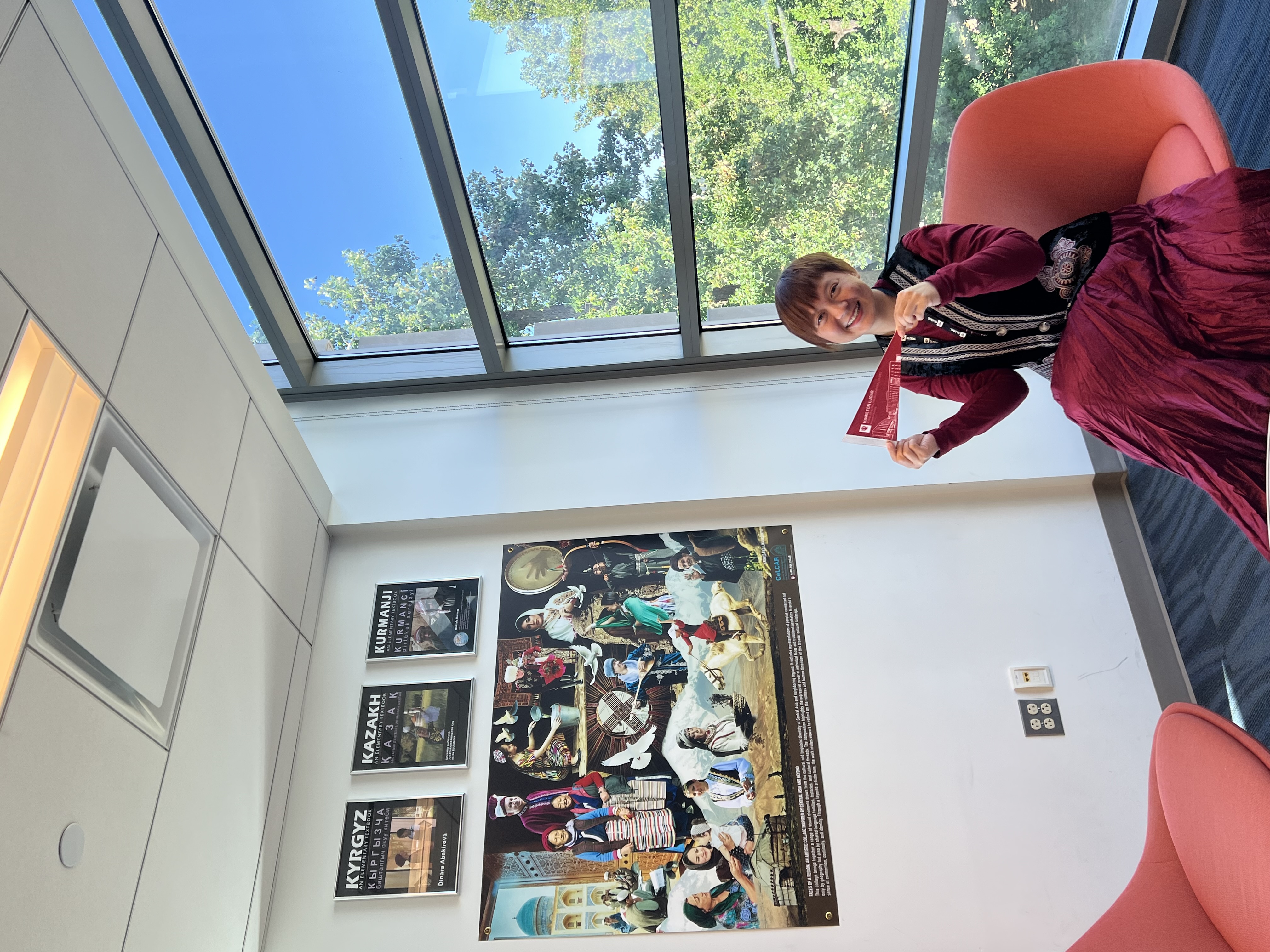
- Can you introduce yourself briefly and tell us a little about your background?
My name is Adina Daniiar kyzy. I am from the southern part of Kyrgyzstan, a region shaped by close contact with Uzbek and Tajik cultures. Before coming to IU, I worked with children, teaching English as a foreign language.
- How many sections of Kyrgyz language are you teaching? How many students do you currently have?
I am teaching two sections: one Intermediate Kyrgyz class and one Advanced class. Overall, 3 students I have.
- What classes are you taking here at IU?
I am taking a course called Language of Emotions with Professor Réka Benczes, who is a visiting scholar from Hungary. I chose this course because metaphors in language fascinate me. I am learning how cultural and linguistic backgrounds shape the metaphors we use. In our class group we have speakers of Hungarian, French, Farsi, and Hindi, which makes the discussion even more interesting.
The course focuses on cognitive linguistics, and we analyze many research studies written by our professor. I enjoy reading the articles she assigns because they help me understand the topic more deeply and allow me to share Kyrgyz metaphors in class. It is also inspiring to read works by scholars like Zoltán Dörnyei, who collaborated closely with my professor.
The other class I am taking is Less Commonly Taught Languages. This course connects to a dream I once had when I first learned about language teaching. I discovered that the American military trains people to learn languages very quickly and effectively, and I always wondered who their teachers were. Now my instructor is actually someone who taught languages in the American Special Forces, and she shares so much knowledge about teaching strategies for less commonly taught languages.
- Is this your first time visiting the United States? If so, what are your thoughts?
Yes, this is my first time visiting the United States and my first time holding a U.S. visa. Coming here, especially to work as a teacher, feels incredible. Seeing how a university operates from the inside and teaching my own language is something I never imagined. It feels like a double blessing: studying in a U.S. university and teaching Kyrgyz at the same time.
I love the academic culture here. I constantly see students reading big books, studying diligently, or working on projects together in the library. The feedback culture - peer learning, observing each other’s lessons, giving and receiving feedback - has helped me grow so much professionally. My lesson planning and learning objectives have improved significantly. Now I think not only about what I teach, but also what my students will be able to do with the language.
- Is there anything you miss from Kyrgyzstan?
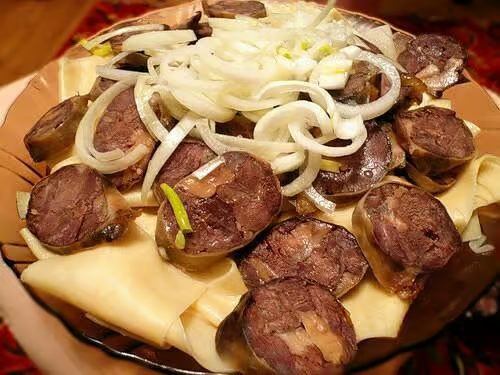
I mostly miss my mother’s delicious chuchuk (horse sausage) and her hot soups. My roommates, however, are wonderful cooks, so I am learning different cuisines too. I used to think salt and pepper were enough spices, but my Pakistani and Kenyan roommates definitely disagree- they even brought many spices from home.
- What is your favorite thing to do at IU when you're not teaching or taking classes?
I wanted to introduce myself to opera, so I have attended English, Italian, and French opera performances as well as live orchestras. It is amazing to sit there for three hours and just absorb the experience. I even noticed children whose parents quietly explained the meaning and nuances of the performance to them.
I also attend cultural and teaching-related events in different departments. One of the biggest achievements for me here is learning how to swim, and also learning to accept my body the way it is. Swimming classes have helped me so much. The SRSC center is full of activities- deep-water exercises, yoga, HIIT, Zumba, and cycling. There is always something to do at IU, and so much to learn from.
- Do you think learning Kyrgyz is difficult for a native English speaker?
It might be challenging at first, but many people I meet here speak three, four, or even six languages fluently. For them, learning Kyrgyz becomes another puzzle to explore. My students already have experience learning other languages, so they approach Kyrgyz with curiosity.
My role is to make the learning process interesting and to keep their passion alive. Kyrgyz has a rich linguistic and cultural tradition - akynship (improvised poetry), dastans, folk tales about geography and animals, star constellations, koshoks (lament songs), and heroic recitations from Manas. Elements like these motivate students to go deeper into the language.
- Is there anything you would like our readers to know about Kyrgyzstan?
Kyrgyzstan is a land of beautiful lakes and high mountains. If you love hiking and fresh mountain air, you should definitely visit.
Extra question: What is your favorite Kyrgyz dish?
My favorite dish is kuurdak- fried meat with potatoes and greens. It tastes amazing with kymyz, our fermented mare’s milk.
-
The IAUNRC takes pride in assisting to host FLTAs at IU during the academic year, and we thank all our FLTAs for their work and invaluable contributions to IU's area studies collectives!